Low-Tech, Message-Rich, Flip Chart
 Slide decks are high tech training tools when used properly help improve information transfer by embedding several types of media as well as text. Too often, they become little more that a high tech chalk board. You remember chalk boards, those black things teachers wrote text on they wanted students to remember. If a teacher took time to write something on the chalk board you know it was likely to show up on the next test. Most slide decks fail to emphasize what is really important. With so much text, there are no powerful points in text based presentations. Like a chalk board, an easel with chart paper is a low tech teaching tool that is portable.
 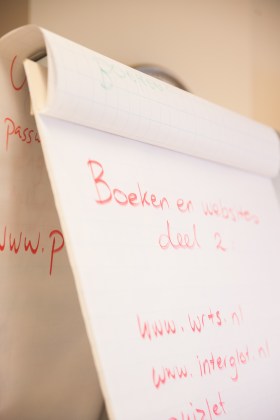 Yes you can write words on chart paper which may serve as a tool to share important points. You can also use chart paper to record students thoughts and ideas during a class discussion. You can pull out those ideas later in the class to reinforce important learning points. When well planned, a good trainer draws a picture as s/he speaks, really draws on the pad a picture. Students are amazed at the trainer’s ability to draw while speaking. Using chart paper effectively in training takes planning, preparation, and practice.
As you work your lesson plan, think about different ways you plan to present material. Slide decks have become the go-to media because trainers sit at their computers and spill ideas related to the information in an outline that becomes their slide deck. Full of text, those presentations could almost serve as a text book read by students negating the need for your class. There are lots of ways You can find ways to improve your slide decks. Look for articles else where on my site, but if you want students to remember what you teach, you need to begin to master more than presentation software applications.
Creating the outline of the points you want to make during a training event is still a great place to start. You use the outline to identifying your learning goals. You do not need to present every learning point to students on a slide deck. Now that you have your lesson outline, you can figure out various learning activities to teach those points. A slide deck is on way. Other learning activities include student discussion, cooperative learning exercises, media presentations, and lectures. Instructors who use only slide decks limit their ability to transfer knowledge to students. Flip charts are a versatile method to improve transfer and retention.
 Using a facilitated discussion allows students to share what they already know. This knowledge may not be known to everyone in class. This method involves the student. Student involvement increases information retention. If this information is foundational to later points in your lesson and you intend to refer back to it, chart paper is the perfect method of capturing and presenting these points.
Many of us know, “a picture is worth 1000 words,” yet still use thousands of words on hundreds of slides to communicate ideas in training. While it seems chart paper was born for text, with a little planning, preparation, and practice, you too can become a chart paper artist. There are two secrets to drawing on chart paper in front of an audience. The first is to plan how to use each page of chart paper during your presentation. For example, on page one you will record things students expect to learn in your course, page two is a list of responses from the class to a discussion question, and the third is a picture you selected to show achievement. You must know which page in the chart paper is going to contain your pictures in order to apply the second secret. Many instructors place notes on each page of their flip chart to keep them on topic rather than using a regular lesson outline.
The second secret to becoming a well known chart paper artist is sketching your drawing with light pencil lines on the selected page before you present. There are two ways you can accomplish this successfully. The first and easiest is to use a projector and trace the important lines lightly with a pencil. The next is the classical grid method. Print an image and impose a grid system over it. Recreate  the grid on your chart paper. Copy the lines from the small print to the large paper lightly with pencil until you have the image you want. In both cases, you can see the lines well enough to recreate the image as you present your message verbally. Your students will not see the lines.
I built on this gem during an instructor development class. During my presentation on using chart paper I asked a student to draw the picture I described. I asked the student in the break before this section to help and share the secret with him. The class was pretty impressed with how well the recorder was able to capture what I was saying without more instruction from me. About half way through the presentation I asked my recorder to select another student to replace him, but not explain how he created what I wanted on the page. This exercise demonstrated the power of using chart paper in a well thought out presentation for all the future instructors.
A third way to use chart paper is recording student responses to discussion questions. This is a great way to save those ideas for activities later in class. Record their responses as closely as possible to what the student actually said, particularly if you plan to use the responses to counter ‘common’ arguments to a course of action. When the time comes to reuse the page in class, you can return to the flipped pages or hang the page(s) somewhere easily viewed.
You need to know some other things to effectively employ chart paper during presentations. Use high contrast colors such as black, red, blue, brown or green. Print large and neatly, do not use script. Letters should be at least one and a half to three inches high. I found printing in small all caps with the first letter larger helps me print neater. Keep your text straight. Use a pad with preprinted lines, or add pencil lines to pages you intend for text. Alternate the color of each line item. Alternate colors help the students understand which ideas belong together. I like to use black for the title of the page and then red or brown with blue or green in the body. Allow students to do your writing for you. This engages them more. Movement helps keep everyone awake and paying attention, very useful after lunch.
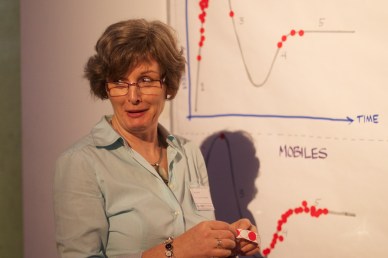 Writing takes time. Use this time to encourage students to take notes as your write. You know they have time to write down important points if you are writing them at the same time. When creating illustrations or charts, students demonstrate improved understanding of processes. They also participate more because they think and reflect as you draw resulting in a livelier class.1 Student participation improves student retention.
Slide decks are great to standardize messages and presentations. They are also a great way to put audiences to sleep ensuring the message is completely missed. When used well, presenters embed a variety of media, not just text, to keep the attention of their students. Even though chart paper is low tech, it is a media form that keeps student attention. Using chart paper requires the presenter to move away from the podium. Chart paper allows the presenter to make important points by selectively writing down need-to-know information. A blank page allows the presenter to draw a picture saving 1000 words of writing while capturing student attention. Instructors can display information from more than one page to be simultaneously allowing reference to the page throughout the lesson. Student ideas on important discussion points can be preserved for later use in class. The simple pad of chart paper on an easel seems passe, but used well, it remains an important tool in the box of any great presenter. Think of all they ways you can use it in your next presentation.
Reference
1. Dlugan, A. Jan 29, 2013. Six minutes speaking and presentation skills. Flip charts 101: How to use flip charts effectively. Retrieved 9/24/2018 from http://sixminutes.dlugan.com/flip-charts-101/
Photo Credits
Author
pxhere.com 0CC license
Beth Kanter: Cambodia4Kids.com CC license
Author
pxhere.com 0CC license


 Some decisions should be delayed, but most can be made quickly. Making decisions at the correct point frees the time by avoiding waffling that robs not only your valuable time, but also energy. Avoid going back and forth over the same options. Making a decision at the appropriate time eliminates stress, confusion and anxiety you feel about making mistakes. Most decisions fail to work out as planned requiring adjustments along the way. Taking greater control builds your trust with others and your confidence to make good decision. Decision-making skills are like exercise. When you exercise more, you develop fitness factors that increase your physical ability. Making decisions increases your self-confidence and your ability to make better decision. You create positive momentum because it’s easier to make decisions when you believe in yourself and your abilities.



 Many organizations confuse training and education. Training is a process of teaching people skills. Education is a process of transferring ideas or knowledge. Often organizations educate people but call it training. People learn ideas and gain knowledge from education. People learn skills from doing the required task. Education is necessary to build skills. Building a skill is not required to aquire knowledge or learn new ideas. This is were the disconnect between education and training occurs. Trainers think passing ideas and knowledge to learners means learners understand how to use the information to complete tasks. For people who posses skill in a given area, this may be true. More often, new learners need practice completing the skill one task at a time after receiving foundation ideas and knowledge. People learn skills by doing.
 In the movie, The Karate Kid, Mr. Miyagi teaches Danny several karate defensive moves through the process of household chores. Miyagi never tells Danny why he is expected to complete certain tasks in the prescribed fashion, only to follow instructions. Eventually, Danny learns the basic skills of karate.
 Completing the educational piece of the training sets up students to work on skills. Whether the skill is making a peanut butter and jelly sandwich, conducting an analysis of data, or building a rocket motor to take a space vehicle to Mars, knowledge is the basis of the skill. Skill building exercises begin the process of changing ideas and beliefs into actions to achieve results.
 Every skill building exercise should be developed to allow students to connect the skill to information learned during the educational portion of the training. Connecting knowledge to skills improves understanding so when things go wrong, students can trouble shoot the situation. Teachers and instructors cannot teach students how to respond to every possible situation they may encounter. Connecting skills to knowledge allows students to effectively solve problems in the real world.
 present opportunities to provide additional information and improve understanding. Use mistakes as opportunities to expand student knowledge of how a task step effects the overall skill.

 He told his classmates he devised a simple system using spreadsheet software to track employee issues. Every morning he made a list of people to contact to follow up on those issues ensuring they were addressed. His actions allowed employees to focus on their work, not their problems. His habit of tracking people’s problems and checking with them periodically, resulted in a reputation of being a compassionate leader. He only spoke with others who had a reason to know about the problem in order to provide support to the employee or help resolve the problem. He did not gossip. His habit of keeping his mouth shut gained him the reputation of being trustworthy. His habits and actions told others the story of how he felt about resolving people’s problems, not a speech delivered from a soapbox about being there to help his people. His character was defined by what he did, not what he said.
 Power is commonly obtained in one of a few ways. The first is positional power, that which an organization give an individual in supervisory positions. Another is expert power. If you are an expert by means of knowledge on a topic, or possess a critical skill that you use and share. You sway others by your expertise. A third source of power is attraction. That ability some people have to draw the positive attention from others and to make others want to be liked by them. Often called charisma, it enables those endowed with it to influence people by bestowing attention on those seeking their approval. A final source of power is reward and punishment. This sounds like something a boss can do, such as providing a wage increase, or dismissing an employee. In this example it is not someone in a position of authority. People who use rewards and punishment for power include people like playground bullies, or a grass roots community activist. Each finds ways to reward and punish people they influence outside traditional organizational structures. Some example include using force in the case of the bully, or endorsing a political candidate in the case of the activist. These rewards and punishments lack official sanction. The power comes from the personal traits of the individual such as strength or speaking ability.
  Learning to develop power across several sources is a skill necessary to influence others. Each has benefits and limitations depending on the skill of the wielder, the situation, and the audience. Each is a tool. One cannot build a house only using a saw; likewise, one cannot lead well with only one source of power.
 This story illustrates the importance of knowing your audience and the message they need to hear. As the instructor pointed out, if the message is what the candidates needed to request to install a flagpole, the communication is different than directing a Soldier to emplace the flagpole. Of course if the Soldiers were less experienced than the Platoon Sergeant, the instructor needed to provide more direction. The senior person in the story understood he was directing another experienced person to complete a task. Detailed instructions were not required.
 confronting unacceptable behaviors and addressing uncomfortable truths, such as failures to reach revenue expectations. Setting standards is action. Leaders execute by jumping in, getting their hands dirty and shoes messy. Doing something dirty is action. Leaders develop power and influence by doing things; acting, not just talking and planning. If you are not doing, you are not leading. Leading is a verb. Verbs are action. Actions, executed properly at the right time by the right right people result in success. You can plan. You can talk. You can be virtuous. You accomplish nothing until you act.
 Viet Nam War Memorial on the Mall in Washington, D.C. with the Soldiers he led in battle. As she approaches and walks along The Wall, she relates memories of her David in various assignments and contrasts them with how she thinks combat veterans she is there with think about their memories of the war, each other, and their beloved commander.
 I found myself contemplating each name that caught my eye. I wondered how my brain selected some names to look at while skipping over others. My thoughts wandered to my own combat experiences. I mentally compared my experiences to those who fought in Viet Nam and eventually to every other war.
 That is why a Gold Star Wife can accompany a veteran wearing a Combat Infantry Badge and feel connected. Each brings their own stuff, projects it on the tall, cold, black stone and The Wall, like a black hole, absorbs it all. Visitors do need not know any one person of the 56 thousand inscribed on those black shiny panels to project their stuff on to it. The Wall accepts everything just as the service members whose names appear on The Wall.
 The Wall, even with all those names carved into the otherwise flawless surface is a blank slate, enabling all to search for meaning. Like the classroom blackboard each person can write the story of how events years ago changed the world and their place in the world. Each finds meaning.
 It is hard to make the colossal statue of Lincoln something else. The size of the World War II Memorial is like the war, massive, so massive it is hard to take in all of it and understand, even after the passing of time.
  The Soldiers marching at the Korean War Memorial are always on patrol, frozen in time, with little room for any other interpretation. Only The Wall absorbs our feelings and casts back what we need to develop understanding.

 Ken Blanchard spent many years working to improve leadership, training people tactics and habits gleaned from successful leaders. His philosophy is tell them, show them, let them, correct or redirect or praise them, and repeat (Be, Know, Do. Blanchard). In an earlier training article, I discussed whys to improve knowledge transfer in the telling stage using checks on learning. This article focuses on the show them stage. Having more methods to teach people ensures you connect with as many learners in your class as possible. If you only tell them things, visual and kinetic learns are left behind. There are several ways to show people. This article discusses three methods of showing; pictures, videos, and demonstrations.
 Picture based slides showing stances, methods, screen shots, and other action are showing. Pictures may contain text for the purpose of showing finer points. You may want to add an arrow for direction of action, or to show points of attention. The image shows how and what to do saving thousands of spoken and written words.
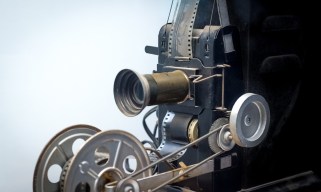 If you create a video, do not simply transfer the classroom lecture to the screen. Use video showing someone doing the skill you are teaching. Sound is not required. You can narrate the action for the class. Consider inserting pauses in the video allowing discussion.
 who only shows a trick once to prevent others from learning how he did the trick, your goal is for students to leave your training knowing the tricks and how to perform them. Repetition ensures your students understand and improves their skill.

 Assign a protegee to the mentor who is dealing with performance problems. Often we think of performance problems as coming from problem employees. Frequently though performance problems come from inexperienced people, or people assigned new tasks without appropriate background or training. Use your subject matter expert to teach this person how to improve. As they work with the newer person, they may find a need to refer back to their original class notes. Good thing they typed them so they are legible! Because you modeled goal setting with your employee, they use that skill to help their protegee set goals. Your newer, inexperienced person benefits from the training provided to the mentor weeks or months ago, another return on your investment. Instead of sending this person to the same training to learn the basics, you book them for something different. When they return, repeat the process and you have a new expert on a different topic.
 There is a better way to make sure your student learn material and for you to know they learned what you taught. Conduct checks on learning during and at the end of your training. Checking learning ensures they heard and retained what you taught. Two simple ways to check learning are simple exercises and questioning.
 Students and trainers come together for the purpose of transferring knowledge and skills to students. Each has a responsibility to enable learning. The trainer’s responsibility is to ensure the knowledge and skills are received, understood, and usable when students leave the training. Checks on learning completed throughout the lesson provide necessary feedback on the success of the transfer. Conducting a review at the end of class by repeating what you previously said is easy. Completing an in-depth check on learning as a review is harder, but shows what has been learned. Students and instructors can leave the training environment confident the new knowledge and skills have been passed and are ready to be used upon returning to their daily assignments.
 When setting goals, task steps are the pavers on your path to accomplishment. Accomplished goals are the cobblestones of your road of life-time achievements. Your achievements define who you are as a person.
 Next, figure out what you desire to accomplish in your life. Stephen Covey talks about what you want your obituary to say. Unless you have reason to believe it is likely you will die in the next three to five years, perhaps thinking about what you want people to say about you in five years may be a better example. As you think about your accomplishments remember the many facets of your life. The facets in your life cause you to focus on events and opportunities in different ways. Some facets of life include personal, family, spiritual, health, community, and professional. A goal that covers multiple areas of your life will feel more fulfilling when accomplished. General people can only focus on fewer that four big goals at anytime. Aligning large and small accomplishments in each area helps improve opportunities for success.

 Whether it is a sales pitch to a valuable customer, a strategy about a change in business practice for your boss, or a training for a group of employees, you know you are about to shine. The lights come up and it is show time. At the end of your presentation, you realize things could have gone better. You ask yourself, “What went wrong?” The answer is you failed to rehearse. Rehearsals are an overlooked preparation, separating professionals from amateurs. No actor would ever step foot on stage without rehearsing; neither should you.
 Rehearsals are like proofreading a document. Few professionals would send out their first draft of a letter. The best have others look over the content, for spelling and grammar. A presentation rehearsal accomplishes the same thing. It allows you to find errors before your audience sees the product. Steve Jobs was notorious for rehearsing dozens of hours before any presentation. TED speakers rehearse hundreds of times before appearing on the red spot.
 Time yourself. Practice with the time counting up and counting down. There are plenty of mobile applications available to help you meet your time hacks. You should know where you need to be in your presentation at particular points in time. Move quickly through your introduction. Quick introductions all time to present main points. Leave at the end to fit a quality conclusion. There is an old adage, “Tell them what your are going to say; say it; tell them what you said.” A rule of thumb for an introduction and conclusion is about 10% of your time for each. That leaves at least 80% of your time for the supporting points of your thesis. End a little short of your allowed time is better than running a few seconds long. The best way to nail your time is rehearsing.
 Record your rehearsal; watch your recording. Reviewing your recorded presentation allows you to edit. By the time you are on stage it is too late. Recording your presentation allows you to hear the pace and volume of your speech. You observe mannerisms, good and bad. You hear words that work well, and not so much. The recording allows you time to fix the bad and improve the good.
 You wonder where you went wrong. The truth is you did a great job. Your boss understands the importance of asking critical questions about everything in the organization. The knows to verify things that appear to be one thing to ensure they are not something else. With experience, the boss learned the right questions to ask related to a host of issues and situations.
 Socratic questions that stimulate discussion and analysis may include:
 Whether you are developing a course of action to market a new product, or deciding where to go on your next vacation, learning to ask the right questions helps you make better decisions. Questions that challenge conventional thinking allow decision makers to identify alternative courses of action and determine if they would be effective. Allowing others to challenge your conclusions with Socratic questioning improves your logical thinking. As you step into your next leadership position, or prepare a briefing for the boss, take time to think about questions to uncover the best solution to any situation.
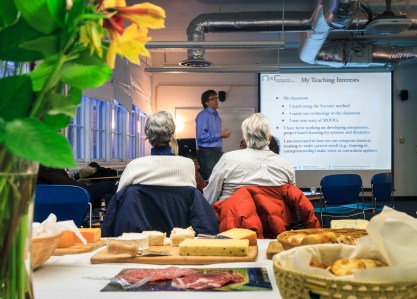 Any popular instruction beyond the basics of how to create slide decks emphasize the importance of graphics. Presenters face challenges finding inexpensive images to really make their learning or persuasion points powerfully. Learning about and finding public domain and Creative Common licensed images liberate presenters from corny clip art and open a world of high quality pictures, clip art, and video free from fees and royalties.
 Flickr is the big name, but not the only source for free images. Google Images provides access to lots of images. Like flickr, not all are free, but like flickr, you can filter your search result to show just public domain or Creative Commons images.
 Pxhere.org images are all Creative Commons licensed with no use restrictions. That means anyone can use or remix any image for any legal purpose according to the website.
  Clip art is more difficult to find, but a good source is openclipart.org. All images are open source. Users should familiarize themselves with the restrictions of each type of license before using images from any source.
