
Leadership is an art requiring practitioners to gain experience by applying known principals to a variety of problems as they arise. People can study about leadership their whole lives. Until they step into a leadership role, they will not know how to lead. Younger people often struggle to gain leadership experience inhibiting workplace promotions. Learning to lead is not a Millennial problem. Youth struggled gaining experience in every generation. So what is a kid, or anyone else who wants to lead others, to do in order to gain experience leading? Join a club! Yes, really join a club.
Leadership is leadership. It doesn’t matter if you are leading a bunch of pre-schoolers to lunch, a Fortune 500 company, or a grass-roots campaign against the latest injustice. Once you learn how to lead, you can lead almost anyone or any type of organization. What matters is understanding what level of leadership you are at and applying the principals required for that level of leadership.
Several years ago I was asked to take a position as a senior leader in the logistics division of my organization. I started my career in the organization as a logistician but found I disliked it and moved into operations. I was counseled by other senior leaders to accept the position because the job required leading other leaders, not directly supervising logistical support.
I accepted the position with a bit of apprehension. I found there was some resistance to my leadership by a few individuals due to my lack of logistics background. Most were receptive to my influence. Those who were resistant left the organization as I began to institute changes to making our division more responsive to the needs of the rest of the organization.
Understand that I am not advocating that the warehouse foreman be assigned to directly supervise bookkeepers in accounting. At lower levels of leadership, front-line supervisors require knowledge of the work being done. What I am saying is that when it comes to supervising other leaders, application of broad leadership principals is required rather than specialized job knowledge or particular tactics for a given situation. That broad leadership knowledge is directly transferable from job to job. You can gain that kind of experience outside the workplace and set yourself up to succeed within your workplace. This win-win tactic not only helps you improve as a leader, but also improves your community, whether geographic, professional, or any other description of community. Run or volunteer for a leadership position in a civic or professional group. After leading a civic group or professional organization you only need explain how you will apply the principals you learned to the specific leadership job you want at your workplace.

Many of the civic or professional groups set up their officer positions to teach new officers about the whole organization. The lowest level officer learns the very basics such as how to set up for meetings. In other leadership positions you learn group’s rules, tracking property, running organizational ceremonies, finances, and controls. Each position eventually runs up to the vice presidency and presidency or the equivalent name for that group. The basics of each position happen to coincide with requirements for leadership in the professional world.
Every business, governmental organization, or nonprofit requires someone to track property, They need people to develop, implement, and enforce policies. They also need to comply with reporting requirements. You do not have to be a certified public accountant as a senior leader in any organization, but you must understand restrictions on spending funds, sources of funding, and reporting. Even nonprofits have filings to complete for the IRS.
Ben Franklin believed everyone should belong to at least three clubs. His reasons included having a network of friends, working to improve the community, and developing skills required to become happier in life. Participating in various leadership positions in a club of your choice allows you to develop skills to achieve happiness and success regardless of your measurement of effectiveness. As you build your network through club participation, you encounter people who are senior leaders in the professional world. Those people are always watching for talent. You may be asked to apply for a position before others become aware it exists. As you work within the community served by your club, you also develop connections within that community outside of your workplace. The people helped also know about opportunities and your good work.
Many civic and professional organizations offer leadership training at no cost. They do so to ensure local and higher level chapters and such have leaders who have some understanding of leadership. The application of principals, tactics, provided in these leadership trainings apply specifically to your group. The principals are universal. The tactic of having two people in a civic group sign checks is based on the principal of establishing and enforcing financial controls. The principal of establishing and enforcing financial controls is universal to leadership. Every business, government agency, and nonprofit needs financial controls. The same idea applies to all leadership principals. The application in the club you belong to will be different than the application at your workplace, but the principals are the same in the club and the workplace. You only need to learn how your workplace applies those principals.
As you can see, there are many reasons to join a civic or professional organization and accept leadership challenges. You have the opportunity to learn and execute leadership. You learn how to influence volunteers; you just cannot be bossy as they will leave the club or your committee (that happens in the workplace too). You learn the foundations of financial controls and limitations of spending and sources of income. You learn how other parts of the organization can help provide resources for training and problem solving. You expand your professional network in ways you could not by staying in your bubble at work. You earn the right to add leadership experience to your resume. If you want to gain critical leadership skills and experience, join a club and led it!




























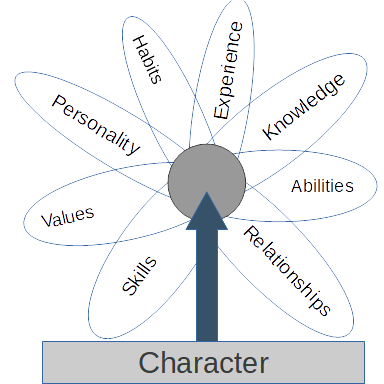 is the sum of a person’s habits and qualities. It is the center of a Venn diagram of your skills, knowledge, abilities, values, relationships, past experiences, habits, and personality. Developing good character helps develop a good reputation, which helps gain influence. Others determine whether or not you are a good leader, or have the potential to be a good leader, by observing common traits in the character of other good leaders. Developing good character traits is within your control.
 That first lesson I learned during field feeding taught me the importance of taking care of those you lead. When your followers know you are taking care of their needs, they know they can focus on their tasks required to accomplish the mission. They know you have their back. That only happens when leaders receive trust from those they lead. Trust turns into respect. Respect creates disciplined organizations. Disciplined organizations accomplish great things in the face of adversity.
 Unlike the other factors discussed above, we only have limited control of our experiences. A person may seek out experiences, but sometimes you have to be in the right place at the right time with an open mind and properly prepared for some experiences. There are plenty of experiences people can control and obtain. You can choose to hike the Appalachian Trail and gain that experience. You can choose to develop a speaking program and present it to several local civic groups to demonstrate expertise in a subject area. Not everyone can go to Harvard, but most people can complete college if they really want and have a college experience. Not everyone can perform in Carnegie Hall, but there are plenty of performance venues if you want to perform.
 The foundations of character date back eons. Periodic reviews, such as this blog, keep lessons fresh in people’s minds. Each of us can change our behavior to improve our character.

 Some decisions should be delayed, but most can be made quickly. Making decisions at the correct point frees the time by avoiding waffling that robs not only your valuable time, but also energy. Avoid going back and forth over the same options. Making a decision at the appropriate time eliminates stress, confusion and anxiety you feel about making mistakes. Most decisions fail to work out as planned requiring adjustments along the way. Taking greater control builds your trust with others and your confidence to make good decision. Decision-making skills are like exercise. When you exercise more, you develop fitness factors that increase your physical ability. Making decisions increases your self-confidence and your ability to make better decision. You create positive momentum because it’s easier to make decisions when you believe in yourself and your abilities.


