
High standards of behavior are required for organizations to successfully complete their missions. Leaders are responsible for setting, training, and enforcing standards in order to create a culture where standards are voluntarily followed. Organizations that establish and expect compliance with standards attract Ike minded applicants. Employees, volunteers, and other stakeholders learn to trust the organization, know the character of their workers, and understand their leaders.
It takes time to codify standards of behavior. Your standard operating procedures, protocols, employment guidelines, and similar documents will be easier to write when everyone knows and understands the organization’s core values or guiding principles. Governing documents misaligned with organizational guiding principles encourage people to act outside those principles. Well written governing documents aligned with core principles ensures people understand how to behave even when they do not know a specific rule. Written rules are shorter, easier to understand, and are more likely to be followed.

Often SOPs, employee manuals, and other written rules take many pages. If the reasons a document is written is based on the core principals, there is no need to restate they whys. Employees who understand the guiding principals will see them in the rules without additional explanations. It is uncommon for all of those documents to be composed at the same time. If the whys are not all based on the common principles, then the authors need all those extra words and pages to spell out the whys for the rules.
Employees, volunteers, and contractors follow the rules better because the standards they establish are aligned with organizational principals. Training time is reduced and retention increased because there is less to teach and learn. As a result, employees will probably do the right thing without even knowing what a rule or procedure is.
Training begins when you first admit someone into your organization. Start with the core principles. Teach your new people what each value means to your group. Give examples of behavior that is compliant and non-compliant. Explain how complying with principles establishes trust across the organization allowing greater effectiveness.

Training supervisors about core principles and methods of enforcing standards is also important. Nothing destroys trust within an organization than repeated reprimands conducted outside the organizational principals. Likewise, failing to correct behaviors outside expected norms slowly eats away at trust developed between key players. Supervisors and other key leaders need to know how to adjust their leadership style to the situation presented.
Paul Hersey and Ken Blanchard introduced the idea of situational leadership in the late 1960s. Since then, others have built on those ideas and demonstrated how to apply the principals of situational leadership to a wide variety of circumstances across the public, private, and non-profit sectors. Taking time to teach your leaders how to adapt their leadership style to meet your organization’s objectives and within your guiding principals increases effectiveness.
After training your new people and leaders about your organizations guiding principals, those standards need to be enforced. When new leaders read statements like this they often envision a drill sergeant demanding basic trainees do push-ups for infractions, or a tough CEO calling an errant employee into the office, chewing them out, and then firing them. These are two possible methods of enforcing standards, but neither works well for long.

On-the-spot corrections for misbehavior can be given in a calm fashion that shows respect and caring. A machine operator found working without eye and ear protection can be told to stop. The supervisor inquires about whether the employee understands what the standard is and why it is important to follow it. If the employee lacks the knowledge, the supervisor provides a quick refresher training and sends the operator to don their protective equipment before resuming their work.
A middle manager who observes such a violation might stop the work and inquire about who the operator’s supervisor is. The supervisor is summoned to the work sight. The manager can use this opportunity to coach the supervisor. In the end, the worker is protected, the organization accomplishes its mission, and the culture of compliance grows.
Making corrections in a respectful fashion and demonstrating expected behaviors helps create a voluntary climate of compliance. People know that following the core principals results in rewards. Failing to comply results in punishment.

Some of you reading this are thinking about why the above statements will never work. You think the union will never allow such supervisory oversight. Some think that leading volunteers requires sometimes turning a blind eye. Others think that they are not in a supervisory capacity and therefore have no ability to influence others. If you are a real leader, you use what power you do have to influence others to comply with the organization’s guiding principals. That may require you to allow others to take action.
In the union example, there frequently are requirements for management to follow certain steps to reward good behavior and punish bad. Meet with union representatives frequently to ensure they understand you want the best people in the organization and the important role the union has helping you keep the good people and separating those who will not comply. The union has a responsibility to equally represent all the workers in their membership, those who perform well as well as those who feel slighted because they are not meeting expectations. Such engagements over time bring union representatives around to looking differently at employee-management relationships.
In the case of volunteers, first ask yourself if you really want a volunteer that behaves in such a way that they endanger themselves, others, or have the potential to cast a dark light on the good work your organization does. Think about ways you can influence volunteers to comply with your guiding principals. People who volunteer believe in the cause. They are easier to influence than paid employees, You have to learn to lead them. It is likely that the threat of separation has a greater impact because their association with you is indeed voluntary. Knowing bad behaviors will not be tolerated ensures compliance. Frequently organizations fail to train volunteers to the same level as employees. Is it any wonder that volunteers may not comply with guiding principals. It is hard to comply with standards they do not know or understand. Taking time to help them understand standards and providing examples of compliance improves trust and helps your volunteers work better. Volunteers who work well improve outcomes for those the organization serves.
Leading team members you do not supervise does pose special challenges. FEMA’s national emergency operation center occupies a large room in Washington, D.C. not far from the Capital. Few of the seats in the room are designated for FEMA officials. Most are set aside for leaders of organizations FEMA works with during disasters. Those members include representatives from the press, various classes of industry, financial associations, think tanks, nongovernmental organizations, non-FEMA government agencies, state, and major metropolitan governments and agencies, and a variety of other interests. None of them answer to FEMA; rather they all answer to their respective organizations. Regardless of who employs each team member, FEMA leads everyone in the room to accomplish the common goal of resolving the disaster, preserving life and property, and keeping elected officials and citizens informed.

Accomplishing that kind of leadership occurs because the FEMA officials use a variety of sources of power to influence each team member. The FEMA leader needs to quickly learn about not only the interests of each organization but also the representatives. They have to apply a different leadership style to each situation. FEMA has often been attacked about ineffective post-disaster relief efforts, but when you think about all the competing interests, it is amazing they accomplish anything. To be effective, those leaders need to establish high standards, teach them to the team members, and then enforce them in such a way others willingly follow.
Setting and enforcing standards is a key responsibility for leaders. If leaders do not enforce established high standards, followers accept lower standards. Leaders establish trust by enforcing standards. In time, enforcement creates a climate of voluntary compliance. Training what behaviors comply and fail to comply with guiding principals ensures everyone knows what the expectations are. Knowledge develops into understanding and permits the organization to operate effectively with few written rules. People know what is expected of them, and what they can expect from others. Trust develops that others in the organization behave and perform at high levels and take reasonable risks. Learning to find the right leadership style for different situations allows leaders to coach, counsel, mentor, guide, and discipline others to comply with organizational standards depending on the circumstances. As a result, the people in the organization focus on taking care of clients and accomplishing the organization’s mission.
/——————— Photo Credits ———————/
- Television Test Pattern: no photographer info available from pxhere.com CC0 license. Modified by author.
- Open Text Book: no photographer info available from pxhere.com CC0 license.
- Overhead Group Meeting: by pixabay.com from pexels.com.
- Youth Baseball Coach: no photographer info available from pxhere.com CC0 license.
- White Water Rafters: by Tom Fisk at pexels.com. Modified by author.
- Turnout Gear: no photographer info available from pxhere.com CC0 license.


























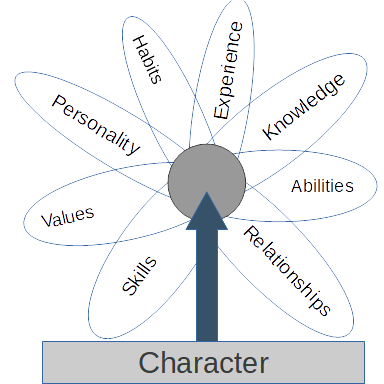 is the sum of a person’s habits and qualities. It is the center of a Venn diagram of your skills, knowledge, abilities, values, relationships, past experiences, habits, and personality. Developing good character helps develop a good reputation, which helps gain influence. Others determine whether or not you are a good leader, or have the potential to be a good leader, by observing common traits in the character of other good leaders. Developing good character traits is within your control.
 That first lesson I learned during field feeding taught me the importance of taking care of those you lead. When your followers know you are taking care of their needs, they know they can focus on their tasks required to accomplish the mission. They know you have their back. That only happens when leaders receive trust from those they lead. Trust turns into respect. Respect creates disciplined organizations. Disciplined organizations accomplish great things in the face of adversity.
 Unlike the other factors discussed above, we only have limited control of our experiences. A person may seek out experiences, but sometimes you have to be in the right place at the right time with an open mind and properly prepared for some experiences. There are plenty of experiences people can control and obtain. You can choose to hike the Appalachian Trail and gain that experience. You can choose to develop a speaking program and present it to several local civic groups to demonstrate expertise in a subject area. Not everyone can go to Harvard, but most people can complete college if they really want and have a college experience. Not everyone can perform in Carnegie Hall, but there are plenty of performance venues if you want to perform.
 The foundations of character date back eons. Periodic reviews, such as this blog, keep lessons fresh in people’s minds. Each of us can change our behavior to improve our character.
 Slide decks are high tech training tools when used properly help improve information transfer by embedding several types of media as well as text. Too often, they become little more that a high tech chalk board. You remember chalk boards, those black things teachers wrote text on they wanted students to remember. If a teacher took time to write something on the chalk board you know it was likely to show up on the next test. Most slide decks fail to emphasize what is really important. With so much text, there are no powerful points in text based presentations. Like a chalk board, an easel with chart paper is a low tech teaching tool that is portable.
  Yes you can write words on chart paper which may serve as a tool to share important points. You can also use chart paper to record students thoughts and ideas during a class discussion. You can pull out those ideas later in the class to reinforce important learning points. When well planned, a good trainer draws a picture as s/he speaks, really draws on the pad a picture. Students are amazed at the trainer’s ability to draw while speaking. Using chart paper effectively in training takes planning, preparation, and practice.
 Using a facilitated discussion allows students to share what they already know. This knowledge may not be known to everyone in class. This method involves the student. Student involvement increases information retention. If this information is foundational to later points in your lesson and you intend to refer back to it, chart paper is the perfect method of capturing and presenting these points.
 the grid on your chart paper. Copy the lines from the small print to the large paper lightly with pencil until you have the image you want. In both cases, you can see the lines well enough to recreate the image as you present your message verbally. Your students will not see the lines.
 Writing takes time. Use this time to encourage students to take notes as your write. You know they have time to write down important points if you are writing them at the same time. When creating illustrations or charts, students demonstrate improved understanding of processes. They also participate more because they think and reflect as you draw resulting in a livelier class.1 Student participation improves student retention.

 Some decisions should be delayed, but most can be made quickly. Making decisions at the correct point frees the time by avoiding waffling that robs not only your valuable time, but also energy. Avoid going back and forth over the same options. Making a decision at the appropriate time eliminates stress, confusion and anxiety you feel about making mistakes. Most decisions fail to work out as planned requiring adjustments along the way. Taking greater control builds your trust with others and your confidence to make good decision. Decision-making skills are like exercise. When you exercise more, you develop fitness factors that increase your physical ability. Making decisions increases your self-confidence and your ability to make better decision. You create positive momentum because it’s easier to make decisions when you believe in yourself and your abilities.


