
Albert Einstein said, “Education is what remains after one has forgotten what one has learned in school.” It is all those things you know, but you could not tell someone how or why you know it. If you think back to your school days and the lessons you learned you would find out that you did not learn as much as you think. You learned the same things over again in different grades. For example you learned about the Mayflower and Paul Revere’s ride in First Grade. When you in perhaps Fourth Grade, you spend another year learning American History but instead of the fairy tale version, you identified and learned what caused the pilgrims and patriots to act. When you studied American History again in middle school, you identified the consequences of the actions of key events and figures in history. In high school, you were asked to think critically about how history could have been different if historical people made different choices. Your learning about American History was spaced over time. Each time you added to what you previously learned. As an adult instructor or leader, find ways to introduce spaced repetition into your training. As a trainer you can build on earlier lessons whether the training event is a few hours or a few weeks.
As a trainer you have a responsibility to develop lessons that build on each other to reinforce earlier lessons and help students understand why skills and information taught earlier are important. Using spaced repetition is easier when your lessons occur over days or weeks. Spacing important learning points in a lesson that lasts only hours is more difficult but not impossible. Start by knowing the learning goals of your lesson. Here is a link to preparing learning goals: https://saintcyrtraining.com/2013/08/27/inspire-others-to-go-forth-and-do-good/.
After you identified the important learning goal of your lesson, you know what points to target for spaced repetition. Arrange your lessons so each learning goal is a logical building block. As you complete lessons for each learning goal, do a quick review to show how learning goals build on each other. Each review serves as a spaced repetition of early lessons.

Another method to employ spaced repetition is to develop practical exercises that require students to use skills learned earlier. For example if you are teaching a group of students to navigate in the woods you would teach them how to read a map, how to use a compass, how to calculate ground distance, and how to calculate the difference between the magnetic and map north readings. After teaching the lesson on distance, you give the students an azimuth and direct them to move along that azimuth for a certain distance. This activity requires them to use the compass and practice the skill of determining distance while moving along the ground. In the final exercise you give them two points on a map to go and find on the ground. This exercise requires your students to read a map, use a compass, calculate the difference in north readings, and measure distance on a map and on the ground. Each exercise builds on earlier lessons and gives an additional repetition space over the course of the training event for each learning goal.
Training events occurring over a longer period of time allow instructors to create more space before each repetition improving retention. Begin each new session with a brief review of prior learning. Ask students to share how they applied what they learned in their lives. Ask for them to report on the results achieved. At the end of the session, ask the students questions to make connections with past lessons. Ask how implementing today’s lessons will improve results by adding the skills learned today to the skills they learned before.

Repeating information throughout a training event allows students to make connections to each learning goal. Students understand how each learning goal related to the others. Students improve their understanding of the overall main idea by making connections between learning goals. Spacing the repetition of the basic building blocks of the main idea reinforce those foundational lessons improving retention. Developing various exercises to support each learning goal allows the student to see, feel, hear, and understand the skill in practice by doing it. Spaced repetition is a great way to improve your students’ skills when they return to their world. They know, understand, and do what they were taught which is the objective of every training; changing behavior. Add spaced repetition to your training and watch the light bulbs illuminate in your students.
Photo Credits
- 1620 by Robin Booker from pixabay.com using pixabay license
- Map and compass by Hendrik Morkel from unsplash.com using unsplash license
- Lightbulb by Fachy Marin from unsplash.com using unsplash license
Use the comment bubble at the top of the page to discuss this content.

 Slide decks are high tech training tools when used properly help improve information transfer by embedding several types of media as well as text. Too often, they become little more that a high tech chalk board. You remember chalk boards, those black things teachers wrote text on they wanted students to remember. If a teacher took time to write something on the chalk board you know it was likely to show up on the next test. Most slide decks fail to emphasize what is really important. With so much text, there are no powerful points in text based presentations. Like a chalk board, an easel with chart paper is a low tech teaching tool that is portable.
  Yes you can write words on chart paper which may serve as a tool to share important points. You can also use chart paper to record students thoughts and ideas during a class discussion. You can pull out those ideas later in the class to reinforce important learning points. When well planned, a good trainer draws a picture as s/he speaks, really draws on the pad a picture. Students are amazed at the trainer’s ability to draw while speaking. Using chart paper effectively in training takes planning, preparation, and practice.
 Using a facilitated discussion allows students to share what they already know. This knowledge may not be known to everyone in class. This method involves the student. Student involvement increases information retention. If this information is foundational to later points in your lesson and you intend to refer back to it, chart paper is the perfect method of capturing and presenting these points.
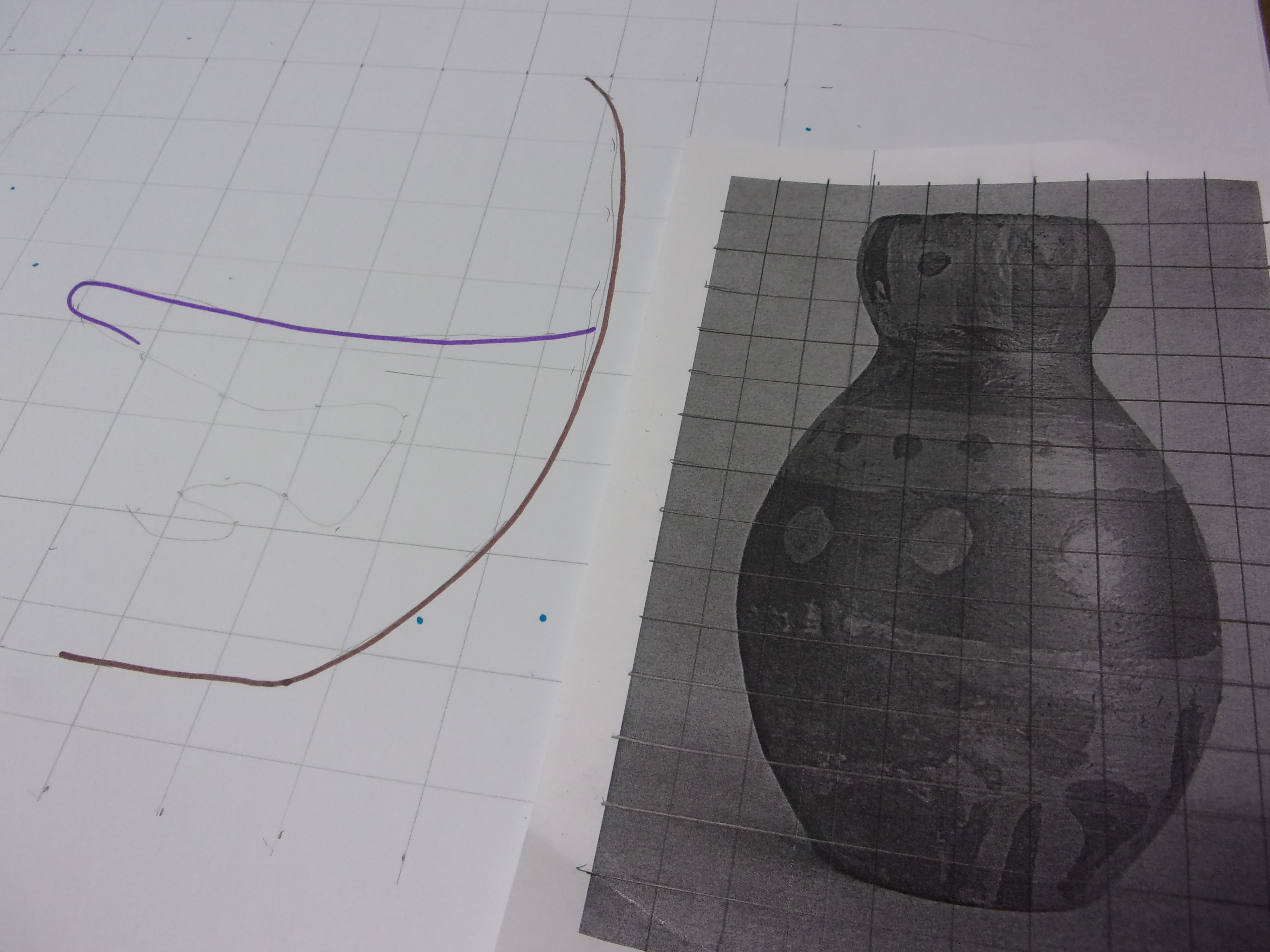 the grid on your chart paper. Copy the lines from the small print to the large paper lightly with pencil until you have the image you want. In both cases, you can see the lines well enough to recreate the image as you present your message verbally. Your students will not see the lines.
 Writing takes time. Use this time to encourage students to take notes as your write. You know they have time to write down important points if you are writing them at the same time. When creating illustrations or charts, students demonstrate improved understanding of processes. They also participate more because they think and reflect as you draw resulting in a livelier class.1 Student participation improves student retention.
 Many organizations confuse training and education. Training is a process of teaching people skills. Education is a process of transferring ideas or knowledge. Often organizations educate people but call it training. People learn ideas and gain knowledge from education. People learn skills from doing the required task. Education is necessary to build skills. Building a skill is not required to aquire knowledge or learn new ideas. This is were the disconnect between education and training occurs. Trainers think passing ideas and knowledge to learners means learners understand how to use the information to complete tasks. For people who posses skill in a given area, this may be true. More often, new learners need practice completing the skill one task at a time after receiving foundation ideas and knowledge. People learn skills by doing.
 In the movie, The Karate Kid, Mr. Miyagi teaches Danny several karate defensive moves through the process of household chores. Miyagi never tells Danny why he is expected to complete certain tasks in the prescribed fashion, only to follow instructions. Eventually, Danny learns the basic skills of karate.
 Completing the educational piece of the training sets up students to work on skills. Whether the skill is making a peanut butter and jelly sandwich, conducting an analysis of data, or building a rocket motor to take a space vehicle to Mars, knowledge is the basis of the skill. Skill building exercises begin the process of changing ideas and beliefs into actions to achieve results.
 Every skill building exercise should be developed to allow students to connect the skill to information learned during the educational portion of the training. Connecting knowledge to skills improves understanding so when things go wrong, students can trouble shoot the situation. Teachers and instructors cannot teach students how to respond to every possible situation they may encounter. Connecting skills to knowledge allows students to effectively solve problems in the real world.
 present opportunities to provide additional information and improve understanding. Use mistakes as opportunities to expand student knowledge of how a task step effects the overall skill.
