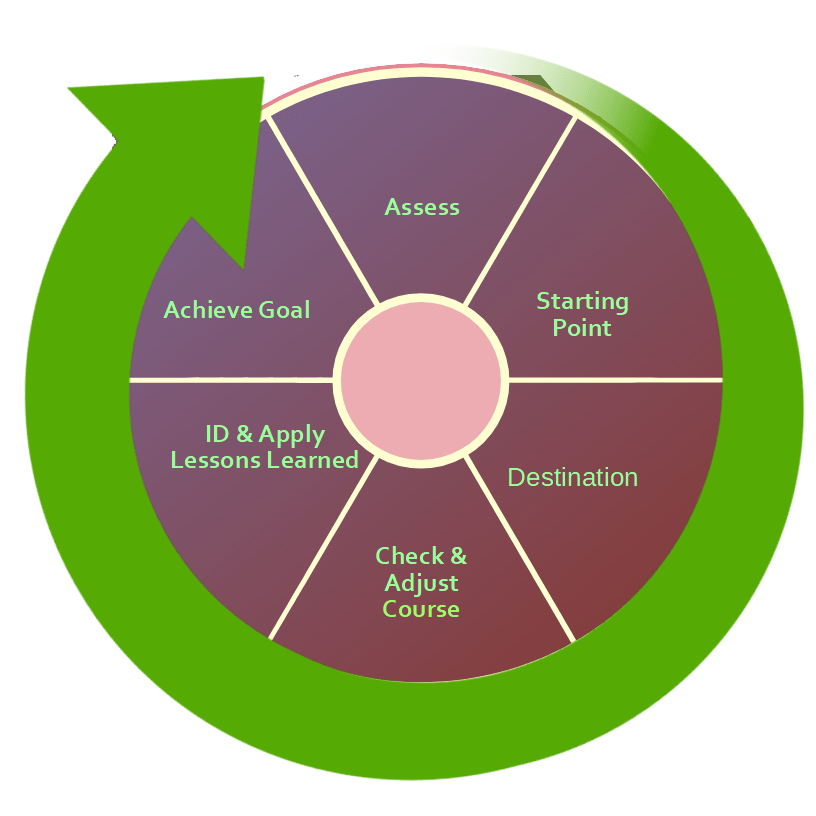
The goal setting cycle is a great model for leaders seeking to help their followers achieve success. The model provides guidance about the process in a way that is easy to explain and understand. There are six steps or stages in the cycle, assess, identifying your starting point, determine your detestation, periodically check and adjust your course, identify and apply lessons learned along the way, achieve your goal. Like many models, some of these stages and steps overlap and rely on other stages for completion. While the model serves as a road map for success, know that the route you select may not be available so you as a leader, you need to be ready to help your follower chart detours. Let’s dive into the stages and how to use them with those you lead.
Assess
This is the foundational state of the cycle. How you apply the assessment depends on how much experience the person you are working with has in life, on the job, and in their current position. The chairman of a board of directors is going to have a much different conversation with the organization’s president than a front line leader with a brand new, right out of school hire. Both can use similar techniques however through the use of appropriate questions. Martha Lask teaches a method called appreciative inquiry. The foundation of appreciative inquiry is leaders asking questions that require positive responses, from a place of gratitude. They must also listen to the answers without thinking about how they will respond. These questions require narrative responses about actions that resulted in achieving successes in the past, and how to apply those lessons and practices to achieve future goals.
Using appreciative inquiry in the assessment step allows leaders and followers to develop an understanding of the followers strengths and weaknesses, interests and desires, hopes and dreams, and experiences that made them who they are. This information is used to identify the starting point for any professional goals, which are the desired destination. The responses inform the leader about the qualities a person possesses so they can determine what tasks to assign in order to achieve the team goals supporting the organization. Additionally, you learn about any additional developmental training or assignments benefit this person’s professional growth.
Conducting a quality assessment is important. Do not confuse good for perfect. The reason a leader helps followers with assessments is because of their experience. The more assessments you conduct, the better you become. Working with those you lead allows them to conduct better assessments soon because of your experience. A direct consequence of showing those you lead how to conduct good assessments is they increase their competency to conduct assessments for any assignments received, and improve the quality of their work.
Starting point
The purpose of assessments is to find your starting point. The assessment finds where you are. When lost in the wilderness, you look for landmarks that help you determine where you are so you can determine which direction you need to move to arrive at your destination. The more landmarks you identify, the greater the accuracy of your starting point.
Think about driving to a location two states away. If your starting point is your home or office, you probably don’t need to input your full address into your GPS because you probably know how to get out of town. If your starting point is in an unfamiliar city, you need those local directions to get started.
The same is true of those you lead. If they are new to the organization, they lack understanding of their surroundings. As their leader, you are responsible to orient them through the assessment process so they know how to get around. Working with more experienced people allows you to refine defining starting points and directions. You use less time orienting them to the local landscape and help them understand how an indirect route provides them experiences that help them grow to meet the challenges on their upcoming journey.
No matter the skill level of those you lead, it is important to have mutual understanding of a person’s starting point. This reduces conflicts as people move forward toward their goals. It establishes expectations by both the leader and employee. A clear starting point is the foundation of any journey.
Destination
As a younger person, I read 7 Habits of Highly Effective People. Stephen Covey uses the proverbial ladder metaphor as an icon to describe our life journey. He cautions people to ensure not only that they are climbing a ladder that reflects their vales, but that it also leaning against the correct wall. As you help those you lead climb the organization’s ladder, you are responsible to help them pick the best ladder and wall based on their values, skills, and experiences. Growth experiences are only opportunities when a person is ready for tat experience. Plopping a person in the wilderness with only a knife and coil of rope p9resents them with a growth experience. However they are more likely to succeed in that opportunity if they had some training on using knives and ropes to survive in the wilderness. Putting a city born and breed adult into the White Mountains Great Gulf Wilderness will more likely result in their death than learning important lessons. The names of injured and killed there includes even well qualified people.

-Photo by John-Mark Smith on Pexels.com
Ensure that those lead are selecting destinations in their goals that not only help them grow, but also help your team and the overall organization grow and meet their strategic expectations. Individual goals that are tied to organizational success create synergy. Aligning individual goals helps ensure people have the resources they need to achieve their goals because those should be the very resources the organization is acquiring to achieve their mission. Leader justify requests for those resources by showing how they are necessary to move the organization to mission accomplishment.
A destination should be rather specific. There should be no doubt when that person arrives. Like providing an apartment number at a street address, one can look around and know they have arrived. There is no question of their success. I think we have all opened our mailboxes occasionally and found a letter address t a neighbor. Sure, the letter got to the right street, It might even be in the correct building, but it has not successfully arrived at the correct destination. When working with employees, it is important that their goal destination be as specific as possible with measurable metrics. Do not send them on a journey to find Sam and then be upset when they tell you about eh afternoon they spent with Samantha instead of Samuel.
Checking In
In the post on setting and establishing goals, I will discuss the importance of writing them down. People who write down their goals have better clarity about their goals and are more likely to achieve them. As a leader, having the goal with task steps written down along with the metrics agreed to by both people enables honest conversations about progress.
Research by Dr. Gail Matthews shows that people with written goals, and develop a system of accountability for taking steps to achieve those goals are 70% more likely to accomplish them. This is where you as a leader comes in. After taking time to help those you lead set and document a goal, meet with them regularly to measure their progress. Work with them to help them understand their mistakes and successes. Between setting a goal, and achieving it, life happens. Things change. Use this time to help your people understand how changes in the environment require them to make adjustments to their path.
Think of the changing landscape like a crash on a highway the totally blocks the road. As a driver, you have choices. You can hang out and hope the road opens quickly. You can get out of your car and walk. You could execute a u turn and find a detour. Your meetings help your followers identify roadblocks and slowdowns so they can pick a course of action that makes sense. Sometimes hanging tight is the right choice, but do not sit still. Identify what other actions you can take during this slow time to prepare for when things are moving again.
These help people move forward two ways. The first is ensuring progress is being made. Are people doing what they know they need to do to move forward. Second is the decision making about slowdowns and road blocks. Both maintain momentum.
Identify and Apply Lessons
Through the check in process, both you and your follower will identify lessons from mistakes or getting lost. The easiest way for a supervisor to identify these lessons and how to apply them is for you to tell people their mistake and what to do to fix it. It is also the poorest way. People learn better if they identify the reason for the mistakes, and develop strategies to avoid making the same mistake in the future, and how to correct for the mistake. That process requires a different set of leadership skills you will need to learn. There till need to stop in and be directive. However, like the discussion of appreciative inquiry above in the assess stage, asking appropriate questions provides deeper understanding for you and your followers. The questions allow them to solve their own problems.
I knew I had become successful in this style of leadership when one of my followers came seeking help with a problem. He said, “I don’t know why I am really here. I am going to tell you my problem. You are going to ask me a bunch of questions that help me figure out the answer on my own, but I still need your help.” He was right. My response was, “Come in, close the door, sit down and tell me what’s on your mind.”
“I knew your were going to say that!
This person knew what the right answer was. He needed guidance to identify the best way to approach the right answer without being directive. He is not the only person to provide feedback on the effectiveness of helping others learn how to solve their own problems.
Achieve Goal
As part of the goal setting cycle, you and your followers identify measures of success. When you conduct your regular check ins with people, compare the current state of their progress against these measures. One day, you will both realize that the goal has been accomplished. Often success is known between check ins and is not a surprise. The measures ensure you did really achieve what you set out to do, rather than just appearing to have succeeded.

-Photo by Manfred Irmer on Pexels.com
Measuring success requires similar questions as the assessment stage. As you near completion of a goal, people start to thing about what comes next. Part of the measuring stage is assessing your new starting point and destination. To paraphrase Dorthy, you may find you are no longer in Kansas. What comes next?
Assess and Begin Again
And the answer is to assess, set a new goal, and begin again. Some important questions include:
- How did the accomplishment of this goal help the person grow?
- What new achievements do they now think re possible?
- What changes helped they achieve the goal?
- How did their success help others succeed (important in developing your team)?
- How can they help someone else accomplish a goal.?
- How can they apply lessons learned from this goal to their next goal?
- What changes would improve the process for the employee?
- What opportunities were missed?
There are dozens of questions in the assessment process between goals. While there are many that are specific to the goal and process, there are also a bunch that apply to any goal and process. The best questions are those that require a narrative from the employee rather than a yes or no response. Also, avoid questions that pose as advise or suggestions.
With this new information, work to set a new goal. There is not rule that a goal has to take a year to complete or that anyone is limited to one goal per year. However, it is best to limit individual goals to three or less at any time. The point of goals is to focus energy. Too many goals at once diffuses the energy. With each cycle, allow the employee to take more of a lead in the assessment and development of the goal. That is the point of working with them on this process, to free the leaders time to do things only the leader can do.
Conclusion
Understanding the goal setting cycle helps leaders guide their followers pursuit of success. Having a system allows the leader to focus on the employee and aiding them rather than figuring out what comes next. In this model, leaders help employees conduct an assessment to identify where they are and where they want to go. It establishes the starting point and destination. Leaders meet with followers regularly, preferably weekly, to review progress and make necessary adjustments. In these meetings, the pair also identify lessons that are being learned and how to apply them moving forward. With a good plan, proper check ins, reasonable task steps, and focused energy, bot the follower and leader develop confidence that the desired goal will be achieved. If progress is not being made. The leader address issues and works with the employee to find solutions, rather than solving the problem for the employee. After each iteration of the cycle, the follower becomes more competent, and less reliant on the leader to achieve success.
References
- Blanchard, K., Zigarmi, P., & Zigarmi, D. (2013). Leadership and the one minute manager: Increasing effectiveness through situational leadership II (Updated ed.). HarperCollins.
- Bushe, G.R. (2012) Appreciative inquiry: Theory and critique. In Boje, D.,
- Covey, S (1989). The 7 habits of highly effective people. Fireside. New York, NY.
- Lask, M. (2020) Frameworks for leadership development. Leader Exchange and Coaching Seminar, Cohort 12, Northeast Regional CAC, Philadelphia, PA
- Martin, G. (2016). Goal-setting research cited by TIME, Forbes, Yahoo, others. Dominican University of California. Retrieved from: https://media.dominican.edu/uploads/LIBR/News-Archives-2016/News-01-2016-GoalSettingResearch.pdf. 2/23/2026
(c) 2026 Christopher St. Cyr
Always written with natural intelegence regardless of how flawed it may be!

