Leading with Appreciation

Not all bosses are leaders. Bosses are, well, bossy and ungrateful. Leaders express thanks. Leaders create safety. Leaders seek input. Leaders provide and willing receive feedback.
-Photo by Lukas on Pexels.com

For too long the image of a boss has been a person who expresses little appreciation for the work of their employees and barks orders expecting immediate compliance. These bosses are not well respected, are marginally effective, and frequently lose people to others. Sometimes well respected leaders act bossy. However, they can do it because of the respect and influence developed by showing gratitude for their before critical situations happen. Leaders that regularly show appreciation they set an important example, achieve better results, retain team members longer, and develop those they lead to become leaders.

In my Trust is the Cornerstone of the Leadership Foundation series, Setting the Example is one of the facets of that Cornerstone. When leaders influence from a place of gratitude, they begin the process of changing the way their brain functions. In turn, when they praise the work of others, and express appreciation for accomplishments, they become known as a positive influence. Others want to work for and follow leaders like this. According to John Antal in Leadership Rising, people who find reasons to be thankful are 25% happier than those who are resentful (page 107). As you publicly express your gratitude to those you work with, bosses, peers, and your team, not only do you become happier, those around you become happier. Publicly praising others increases your influence, which improves your leadership power.

Like any skill offering apprciation and gratitude rquires practice. The more you practice thanking others for their work and contributions, your offers of praise improve. You help create a culture of gratitude and begin the process of developing the next generation of leaders.
-Photo by Mikhail Nilov on Pexels.com

Feedback helps those you lead to grow. This means you need to speak with your people about the quantity and quality of their work on a regular basis. Waiting for an annual review is too late to praise or correct. I once had a subordinate leader who was struggling to influence his team to accomplish assigned tasks. I am often in the spaces where people work in order to watch and learn. During several of my walk abouts, I noticed a particular leader provided information to his team well. He failed to assign tasks to team members, or seek input when possible about ways to accomplish the tasks assigned to his team. When I brought this to his attention, he said they should just know what to do. I asked him how they were supposed to know what to do unless he told them what parts of the task were their responsibilities. He stared at me. We discussed the importance of not only directing the overall work to be done, also assigning parts of the task to an individual so they would know what was expected of them. We also reviewed the importance of checking back to ensure people were meeting the expectations. I worked with this leader for a few weeks, but it wasn’t long before leaders senior to me noticed the team’s lack luster performance in a fast-paced operational environment, and he was terminated. People only know what to do and how well they are doing when we provide feedback as leaders. Opportunities exist to express gratitude every time leaders offer feedback for observed improvements.

Leadership is influencing others to implement behavioral changes to accomplish the organization’s mission. Leaders who lead well surround themselves with quality, motivated, competent, but imperfect people. Too many conversations about improvement begin from a position that something is wrong. Using an appreciative inquiry model allows leaders to acknowledge the great things people do. Appreciative inquiry recognizes all individuals and organizations have room to improve. Start improvement discussions by appreciating what people accomplished and express gratitude for their efforts. This creates safety, allowing them to consider what changes improve the good they accomplished to something better. Asking appropriate, probing questions to identify shortfalls and possible improvements provides personal investment for the changes the leader seeks. This process reduces resistance to change and improves outcomes because those creating the change, developed the plan. Gratitude is the foundation of the process and provides physiological safety required for effective teams. Appreciative inquiry also develops the next generation of leaders as they learn how to identify and fix problems.

Giving thanks to others develops leadership influence. Asking appreciative questions allows others to solve their own problems. Offering gratitude builds a foundation to build your team.
-Photo by Pixabay on Pexels.com

Expressing gratitude is an effective way to lead others because it builds trust and safety for your team. When you express appreciation for the good things others do, you set an example for others to follow and establish a positive culture. From this foundation, you become known as a thankful leader which provides you greater influence with those you lead, your peers, and your leaders. Appreciative feedback ensures those you lead know what is expected of them, they will be recognized for the efforts, and are more likely to produce effective results consistently. Effective leaders use appropriate, probing questions. Those questions help establish what things are going well and allow followers to identify improvements. Followers discover for themselves how they can implement effective changes that improve success for them and the organization. Through these appreciative practices, people are more effective, create positive change, increase leadership power, and help the next generation of leaders develop from their leader’s example. In this season of thanksgiving, think of ways you can improve your gratitude practice with those you lead, reap the rewards of improved effectiveness, and empower your people. Thanks to all my faithful and regular readers.

References

Antal, J. (2021) Leadership rising. Casemate Publishers. Havertown, PA

Bushe, G.R. (2012) Appreciative inquiry: Theory and critique. In Boje, D., Burnes, B. and Hassard, J. (eds.) The Routledge Companion To Organizational Change (pp. 87-103). Oxford, UK: Routledge.

Duhigg, C. (2016). What Google learned from its quest to build the perfect team. The New York Times Magazine. Feb 25, 2016 ed. Retrieved from https://www.nytimes.com/2016/02/28/magazine/what-google-learned-from-its-quest-to-build-the-perfect-team.html on 4/11/2022

Giuliano, G. (2024) Coaching for (a) change: How to engage, empower, and activate people. (1st Ed.) Wren House Press. E-Book.

Lask, M. (2020) Frameworks for leadership development. Leader Exchange and Coaching Seminar, Cohort 12, Northeast Regional CAC, Philadelphia, PA

Miller, C, Aguilar, C., Maslowski, L, Et al. (2004) The nonprofits’ guide to the power of appreciative inquiry. Community Development Institute. Denver, CO.

(c) 2025 Christopher St. Cyr

Always written with natural intelligence, no matter how flawed!

Veterans Day: The Challenges and Coins

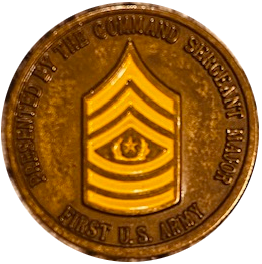
a picture of the challenge coin from the first army command sergeant major.
This is the coin I received from the First Army Command Sergeant Major in 1998. This and a five dollar bill will get you a cup of coffee at Starbucks or Dunkin, and in some circumstances, maybe a free beer at the enlisted club. While the coin may lack monetary value, it has a great deal of sentimental value for this old Soldier.
-Photo by author

April, 1998, I found myself attending drill in Orlando, FL with the New Hampshire National Guard State Command Sergeant Major. On this drill weekend, the rest of my battery was in Jericho, VT shooting howitzers in the snow while I enjoyed beer in a hot tub in Florida. I had been selected as the 1997 Noncommissioned Officer of the Year for the New Hampshire Guard. The eastern regional competition was in Orlando that year. Someone else won the competition at this level, but all the competitors received a challenge coin from the First Army Command Sergeant Major, CSM Kenneth Cummings. This was my first, but not the last, challenge coin I received in my military career.

Challenge coins are an old military tradition. If you research internet sources, you will likely find versions of three stories about the origin of challenge coins. The first dates back to Roman times, when the leaders of Roman Legions had coins minted with the Legion emblem. They were awarded to Legion Soldiers for honorable actions. The next is a story of a World War I pilot who feared he or members of his unit would be shot down behind enemy lines and then shot by allied forces while attempting to cross into friendly territory. He had tokens minted with the unit heraldry and issued them to all the pilots for proof of identity. A third common story dates back to watering holes in Vietnam. Soldiers who lacked some memento to prove they had engaged with the enemy in close combat were required to buy everyone in the club a round.

However, there are two other stories I know related to challenge coins. The first is from an episode of Turn, a television series about GEN Washington’s spy network. In this episode, one of the characters is challenged to prove he is a member of the network. He produces a coin, mixed in with other coins of the land, to show he works for Washington. Another story is in the book written by COL (r) David Hackworth, About Face: The Odyssey of an American Warrior. I would cite the page of this story, but I am not digging back through a 900+ page book to find it! COL Hackworth tells a story about issuing every Soldier in his Battalion a card with his personal and operations center’s contact information. Every Soldier was required to carry the card with them at all times. If they found themselves in some sort of trouble, they could call for help. This card was an inspectable item. Members of the Battalion were often challenged to produce their card.

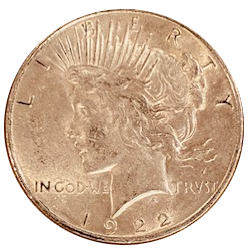
picture of a silver dollar presented to the author by second lieutenant Krauklin when he was commissioned.
This is the siler dollar presented to me by then 2LT Krauklin. He still serves as a commissioned officer today. We worked together again after his commisioning.
-Photo by author.

Another coin tradition is that of the First Salute. Upon receiving his or her commission as a Second Lieutenant, Officers give a silver dollar to the first enlisted Soldier to render them a salute. Today that tradition is built into the commissioning ceremony. Near the end of the ceremony, each new 2LT is called forward to receive his or her first salute. The enlisted person is selected by the new Officer and is commonly a person who had a positive influence in their life.

In 2004, I was deployed to Baqubah, Iraq along with about 100 other American Soldiers at a downtown Police Headquarters. SGT Peter Krauklin was one of the Soldiers who worked in our operations center, the vital communications link between the Soldiers guarding our tiny perimeter, out on patrol, and with our higher headquarters. Krauklin was a last minute addition to our unit when it was activated. He had zero friends or acquaintances when he arrived. While I cannot say I went out of my way to make him feel part of the team, that is my method of operation. After my second deployment, I was promoted to Master Sergeant and reassigned to the Modular Training Company,195th Regiment (NH Reg Tng Inst) as the Chief Instructor. I was required to complete several training programs to be qualified, including the Platoon Leader Trainer Qualification Course, conducted by the 195th’s OCS Company. A student in that class was OC Peter Krauklin. When OC Krauklin completed OCS the following September, he selected me to present his first salute at his ceremony. Of the many coins I have, the silver dollar I receive from 2LT Krauklin is one of my most cherished.

Photo of the 42nd Infantry Division Command Team coin which shows 1/2 of a rainbow representing the loss of 1/2 of the Soldiers in World War I
This coin from the 42nd Infantry Division was awarded to me by both the Commanding General during a visit to our unit in 2022, and his Command Sergeant Major in 2023 at his Change of Responsibility Ceremony. I told the CSM his CG had already given me one.
-Photo by author

I often encourage others to do more than thank service members and veterans for their service. Instead, ask them to tell a story about a memorable time from their service. One way to get a vet to open up is asking if they ever received a coin. Ask if they have it with them and to tell the story of how they received it. Many times military members, past and present, have official awards and medals, but for personal reasons, they may not want to talk about them. Coins however are unofficial awards, or sometimes personal purchases to remember a place or event. Soldiers want to talk about those situations. Asking about their coin is one way to better understand the service and sacrifice of those serving or served in the military.

Units will often mint coins for their members to memorialize specific events. The coins will be available for members through purchase or provided by leaders with their own funds. One of the most common reason for every unit member to receive a coin is deployment. A company or battalion will design a coin that is specific to service in that period of time. Such coins are completely appropriate with the history of challenge coins, as the only way to receive a copy of that particular coin is to belong to the unit at the time of issue.

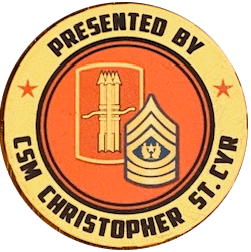
This picture shows a coin the author had made to present to Soldiers. It features the 197th Field Artillery patch consisting of five arrows joined together representing each of the original five counties in New Hampshire, and the rank insignia of Command Sergeant Major.
As the Command Sergeant Major of the 197th Field Artillery Brigade, the Army provided 50 coins for me to award to Soldiers. I did not feel that was enough, so I order my own. The Army also had strong rules about how to present coins that did not apply to the coins I purchased. I know there are Soldiers across the military will tell the story of how they received this coin for years. -Photo by author.

While the origin of challenge coins will never likely ever truly be known, they have become a symbol of belonging. Coins represent the stories of a Soldier’s career. Those small tokens represent their participation in events that become history. Coins demonstrate recognition for accomplishments, belonging, and excellence. Each has its own story of service, sacrifice, honor, and is part of the legend of military service. When you see a current or past service member, after thanking them, ask if they have a challenge coin. Then ask them to tell the story of their coin. You can bet that no matter how few or how many she or he has, they can tell you the story of each of them.